Article
Jan 7, 2026
Why Functional Teams Will Decide the Success of AI in Your Organization
Sujeet Mishra
AI success isn’t just an engineering problem. This article explores why functional teams—HR, Sales, Marketing, Operations, and more—hold the key to sustainable AI adoption, and how turning them into builders unlocks real business impact.
When we talk about AI progress within organizations—and across the broader ecosystem—the conversation often centers on engineers. And rightly so. But having spent years as an engineer myself, I’ve come to believe that AI’s true success depends just as much, if not more, on functional teams.
By functional teams, I mean HR, Marketing, Finance, Operations, Sales, and every group that lives closest to the business and the customer.
From Supporting Work to Getting Work Done
To understand why this matters, it helps to look at how AI differs from earlier waves of technology transformation.
Digital transformation gave us better workflows and systems of record. It helped humans work more efficiently. AI, however, is fundamentally different. AI systems are not just about enabling work—they are about getting the work done.
And who truly understands how work gets done in an organization?
Functional teams.
They live and breathe the business every day. They understand the nuances of customer behavior, internal processes, edge cases, and exceptions that rarely make it into documentation. This context—deep, tacit, and often undocumented—is what makes AI systems truly effective. Yet enabling these teams is still an area many organizations underinvest in.
Turning Functional Experts into Builders
Most of an organization’s operational knowledge doesn’t sit in code repositories or system diagrams. It sits in people’s heads. And simply giving these teams access to tools like ChatGPT Enterprise is not enough.
The real unlock comes when functional experts stop being passive users of AI and start becoming builders.
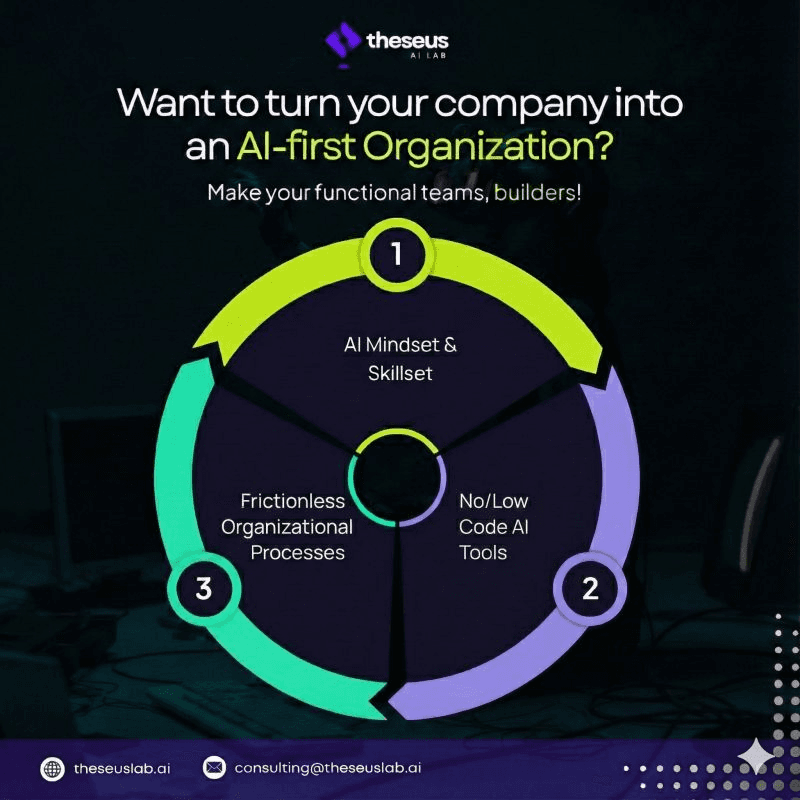
That shift requires three things.
1. Building the Right Mindset and Skills
Traditionally, functional teams have been high-level users of technology. They know how to use tools well, but they haven’t always been invited to build with them or participate deeply in shaping solutions.
As a result, their involvement in AI initiatives often remains surface-level. To change this, organizations need to deliberately cultivate a builder mindset—one where functional teams feel empowered to design, experiment, and contribute meaningfully. Skill-building is essential here, but so is changing the mental model of what their role can be.
2. Equipping Them with the Right Tools
Providing enterprise AI licenses is a good starting point—but it’s only the first step.
To truly unlock value, functional teams need no-code or low-code AI tools that allow them to translate ideas into working solutions. Many organizations are beginning to deploy internal AI builder platforms or tools like n8n to bridge this gap.
Some may argue that building systems isn’t the job of functional teams. But when they are involved, the impact is unmistakable: better ideas, faster iteration, and a level of ownership and confidence that top-down initiatives rarely create.
3. Enabling the Right Processes
AI adoption doesn’t scale sustainably from the top down—it grows from the bottom up.
For that to happen, functional teams need clear processes, access, and autonomy to move ideas into production. This means reducing approval bottlenecks, cutting unnecessary bureaucracy, and creating safe spaces to experiment.
Of course, all of this must happen within well-defined guardrails—aligned with IT policies, security standards, and strong data governance. But within those boundaries, teams need freedom to explore and build.
The Real AI Advantage
Organizations that win with AI won’t just have the best models or the strongest engineering teams. They’ll be the ones that successfully activate the people who understand the business best—and give them the mindset, tools, and processes to build.
That’s where AI stops being a buzzword and starts becoming real leverage.